Lots to share with you from 2025…
First, the paperback of my book, Bootstrapping Computing, is available for preorder now, and will be released on December 1! Here’s a quick summary:
The book is about how ten layers, starting from binary, were arranged to build up to personal computing and the World Wide Web. Each layer is built out of the simpler parts of the one below, arranged to produce increasingly sophisticated ideas of what computing could be. It’s an incredible story of human ingenuity.
The paperback’s cover features a beautiful original illustration by Owen D. Pomery, and the entire book is printed in full color.
Grab a copy for yourself or a friend this holiday season - I hope you enjoy it!
Some recent work in this section, and some personal updates in the two that follow:
A few weeks back, I published a second part to The Interfaces With Which We Think. It’s about the moral imperative for composable systems and malleable software.
Earlier this year, I recreated the user environment found on the Canon Cat, a 1987 follow-up to the Macintosh by Jef Raskin. This was a really wild idea of personal computing: the entire OS’ user environment was, essentially, one long document.
I explored its implications after living in the environment for about a week in a lab report on my member site, now made publicly available. I also published my recreation for you to try out there.
There’s another member essay I made publicly available observing the process by which my work happens.
Most recently, I’ve been working on an itemized user environment to live in full-time — the kind I’d want to see on a full implementation of an OS with the kinds of ideas envisioned in my lab notes and experiments over the last few years. In new lab reports for members, I’ve published deep dives into the system’s data model and filesystem replacement and the system’s language. The next update, out soon, will discuss the approach to designing the system’s architecture, and from there, we’ll head into the interface.
This has been the fullest implementation I’ve approached yet. It has taken years of experiments to fully understand a lot of the little details that would snag attempts in the past. I’m cautiously optimistic about this build.
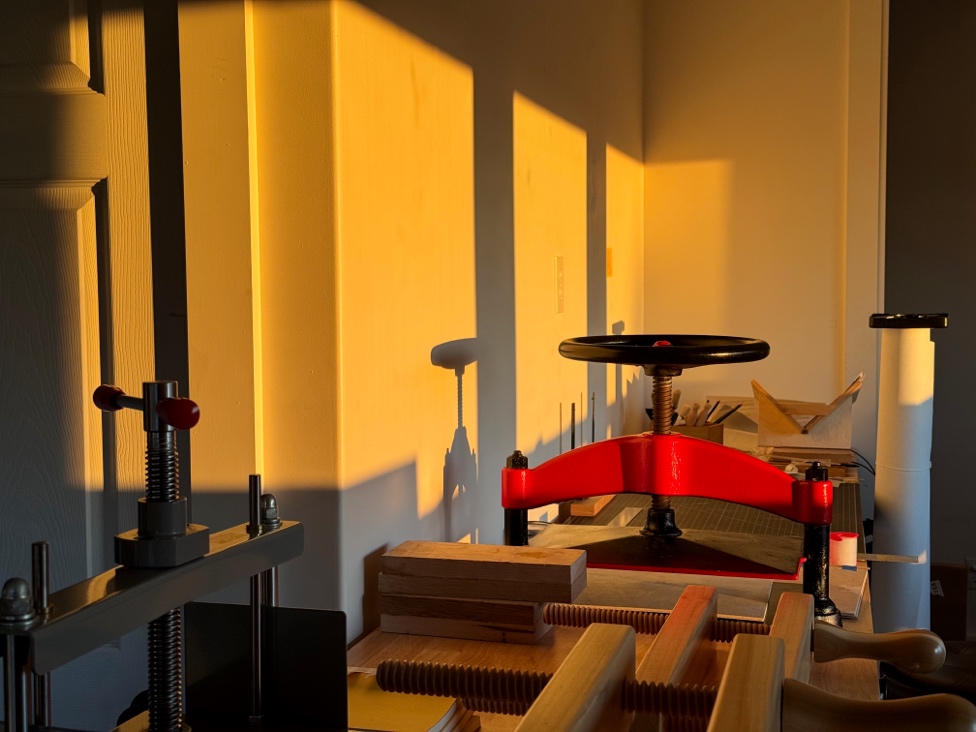
This year has brought lots of change. Sarah and I started Buddy Bindery & Press — I wrote some on our first year in business here — and we moved to New Hampshire. When the bindery outgrew our existing space, we started looking for a new one. We also wanted to get closer to Boston, where Sarah’s in grad school.
We found a lovely ten acre homestead in the mountains, heated by a lone wood stove in the middle of the cabin. Lately, my days start around five or six in the morning at the wood stove, getting the morning fire going to break the night’s chill. Usually with a coffee in hand, and always with the cats overseeing the work. Then I get into making the days books, or some research and reading.
Between all the bookbinding, as well as all the wood stacking, splitting, and other such tasks, I’ve had a lot more time for audiobooks this year. I’m currently in the middle of On the Origin of Time, which is turning out to be my favorite new read of the year. It does an excellent job of describing both how certain ideas work, as well as how their fomenters meandered into them. And when those ideas are the time dimension and a spatial dimension kind of switch roles inside of black holes, things get interesting fast.
This was also done quite well by the book on Bell Labs, The Idea Factory. (My only complaint with that book — and it’s a big one — is that, of all the ideas it helps you understand the formation of, Unix is given only a passing mention in a fraction of a sentence.) Tim Berners-Lee’s Weaving The Web also does a great job of this, helping you get into his headspace when he dreamt up all of the necessary peculiarities that became the Web.
I love this kind of book: help me to understand a wild idea, and how people thought such a thing up. My hope was to do just this with my book — I hope it delivers. Dealers of Lightning, on Xerox PARC, is a good counter-example: it does neither, instead mostly flogging middle management’s various politics for missing out on some of the biggest inventions of our age — not terribly interesting reading, unless you’re a manager in need of yet another cautionary tale. It glosses over the many wondrous ideas that came out of PARC and how they were hatched by the many figures now of computing lore.
The publishing company and bindery has been a wonderful source of surprises and problems to solve. Besides writing and designing our first book, I decided to hand-make the hardcover edition.
I’m not sure why, but I thought we’d get 20 orders. I would have been stoked with that! Sarah thought it’d be more like 50. We were both wrong. We eventually sold 350 before we had to turn the thing off so I could catch up.
We had to get lots more supplies, but at some point in the process, the paper we were using was discontinued by the manufacturer. So we spent some weeks hunting down the last remaining reams at paper suppliers around the country.
Making so many books by hand has been therapeutic. It’s even helped me enjoy my computer work more. I think there’s some forced balance there that I need. Back when we lived in an RV, I had this in spades: every day required some various tasks on the rig, and a couple drives a week through evolving North American landscapes helped keep my head in the right place. But without this kind of balance, I tend to go too deep into my work on the computer, without any benefit to me or the work.
So with that in mind, I’ll log off, and get to the books.
I hope all is well in your part of the world.
– Alex